The Conversation
What first inspired Drowning?
Rebecca Baker
Drowning began with a question: what does PTSD actually feel like from the inside?
So much of what we see on screen focuses on how trauma symptoms look to other people. I wanted to explore the experience from within; the hypervigilance, the emotional exhaustion, the isolation, the feeling that your own mind no longer feels like a safe place to be.
The story draws on my own experiences navigating PTSD, mental health treatment, the legal system and recovery. During that period of my life, I struggled to find portrayals that reflected the reality of what I was experiencing. Drowning became a way of exploring those feelings through storytelling and, hopefully, creating greater understanding for people who may never have experienced PTSD themselves.
Drowning explores trauma, memory and recovery through a psychological sci-fi lens rather than straightforward realism. Why did that feel like the right way to tell this story?
Reiff Gaskell
Documentary gave me a huge respect for lived testimony, but it always meant looking from the outside in. Fiction let us collapse that distance, and genre gave us the freedom to put the audience inside Elle’s world rather than asking them to just take her word for it. We were mindful of staying faithful to Rebecca’s experience without getting too close and risking her welfare, so the sci-fi setting let us build our own atmosphere while still respecting where it came from.
Rebecca Baker
I was more interested in exploring the emotional reality of PTSD than recreating the specific events that shaped my own experience.
For me, fiction creates enough distance to explore difficult truths honestly, and the psychological sci-fi lens gave us a way to externalise feelings that can be incredibly difficult to describe.
Setting the story in a near-future London also allowed us to ask wider questions about trauma, mental health and human connection, and where we may be heading if our understanding of them fails to keep pace with the rapidly changing world around us.
How did you approach bringing the internal experience of PTSD to the screen?
Reiff Gaskell
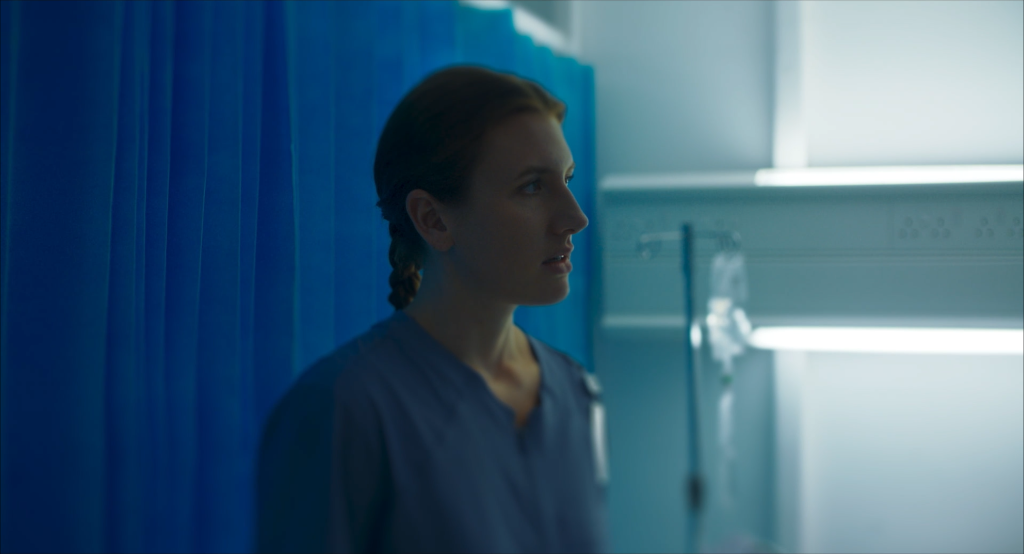
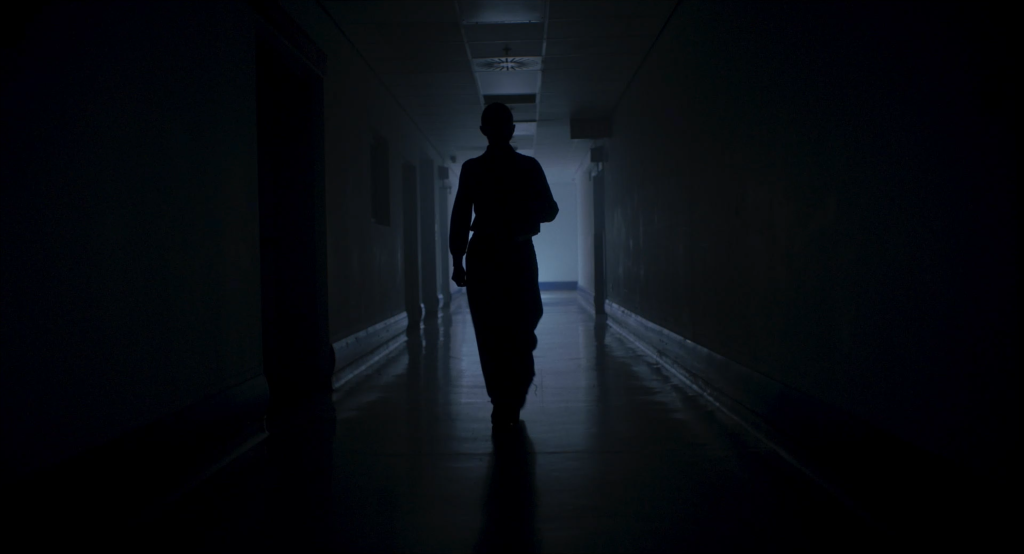
We built the approach around the idea of drowning quite literally – somewhere between deep water and claustrophobia – where Elle carried a huge, unseen weight with her, dragging her down. Cold greens and blues ran through every space where Elle experienced distress, with harsh overhead lighting and a green tinge that crept in as her control slipped. Sound carried just as much weight: a constant, subtle distortion through most of the film, like having your ears half-submerged.
Why was it important to tell this story through the perspective of a nurse?
Rebecca Baker
My own experiences gave me enormous respect for healthcare professionals. Many are exposed to extraordinary levels of stress and trauma whilst continuing to care for others every day. I wanted to explore that contradiction: how does someone recover when life keeps finding new ways to wound them?
What conversations did you have throughout development about portraying PTSD authentically?
Reiff Gaskell
We knew early on that the film was about trauma recovery, not about the assault itself, so a lot of our conversations were about resisting shorthand – the single flashback trigger, the clean before-and-after arc – because recovery rarely works like that. We stuck closely to Rebecca’s lived experience, which was more of a confusing cycle than a straight line, which is why the film’s timeline doesn’t follow a clear before or after either. Sitting in on a recovery support meeting with Rebecca, to understand what being held and heard by strangers actually feels like, was one of the most affecting parts of the whole process. From there it was about translating that into camera, light and sound, and asking the same question in every department: does this feel truthful to what living inside this experience actually feels like?
What responsibilities come with making a film about trauma and mental health?
Alice Duke
As the producer of Drowning, I think my responsibility has been to approach the subject with care, honesty and respect. PTSD affects millions of people and yet it’s often misunderstood or reduced to stereotypes on screen. It was important to us that Drowning explored the reality of trauma with compassion and authenticity, whilst remembering that our protagonist, Elle, is more than her diagnosis.
There is also a responsibility to create a supportive environment for the cast and crew working with challenging material. Ultimately, we wanted to tell a story that felt truthful, human and empathetic, and that encouraged greater understanding of experiences that are often invisible.
What conversations do you hope Drowning encourages, and what role can storytelling play in changing how people understand PTSD?
Alice Duke
I hope Drowning encourages more open conversations about PTSD and challenges some of the assumptions people may have about what it looks like. For a long time, PTSD was largely associated with soldiers returning from war suffering from ‘shell shock’, but we now know it can affect anyone who has experienced trauma. Despite that, many misconceptions still exist.
Storytelling has a unique ability to build empathy. It allows audiences to connect emotionally with experiences they may never have encountered themselves, and that connection can often be more powerful than facts alone. If Drowning helps people better understand the realities of PTSD, or encourages someone to feel less alone in their own experiences, then that’s incredibly meaningful.
Nicholas Pinnock
We are in a time now where it’s impossible to ignore not just how unsafe women feel but how unsafe women are. Adding that to the rising awareness of mental health issues – in this case PTSD – there’s a responsibility as creatives to tackle the problem on screen in a way that speaks to those who are aware of the issue, those who aren’t and those still choosing to ignore it. Rebecca wrote a very well crafted script giving the audience an insight into the working mind of a woman with assault-induced PTSD, that I feel people, especially women, will discuss. Sadly, I don’t know many women who haven’t felt threatened or unsafe to some degree in their local community. It’s something we need to talk about and discuss how to solve and media is a good introduction to sparking these kinds of conversations. PTSD is on the rise and sometimes can live with a person for a long time before they’re even aware. It’s often a misunderstood and dismissed condition that can lead to many things like substance abuse, self harm, hyper-independence and the list goes on. Hopefully, again through our film Drowning, the audience will have a better understanding of and remove some of the stigma surrounding it.
Rebecca Baker
I hope the film encourages greater compassion, both towards others and ourselves and I hope it challenges assumptions about PTSD, addiction and recovery. I hope it reminds people that there is nothing broken or shameful about the ways our minds and bodies respond to trauma.
Facts and statistics help us understand an issue, but stories allow us to feel it. They invite us into somebody else’s perspective, and that’s often where empathy begins.
Did working on the film change the way you think about PTSD, addiction or trauma recovery?
Amelia Bullmore
The script helped me understand how fragmented and non-linear recall can be for people dealing with PTSD – rather than a much more literal idea of flashbacks I’d had before. Also the sense of restlessness and finding commitments and social arrangements challenging. Those were new and valuable insights for me.
Why was partnering with PTSD UK important?
Alice Duke
From the beginning, it was important to us that Drowning wasn’t just telling a story about PTSD, but contributing to wider conversations around understanding, support and representation.
PTSD UK has done incredible work raising awareness of PTSD and supporting those affected by it, so partnering with the charity felt like a natural fit. Their involvement brings valuable insight and credibility to the conversation, and helps ensure the film sits within a broader effort to challenge misconceptions and encourage greater understanding of trauma and recovery.
We hope the partnership helps the film reach people who may see aspects of their own experiences reflected in the story, while also encouraging audiences to learn more about PTSD and the support available.
If someone living with PTSD watches Drowning, what do you hope they take away from it?
Rebecca Baker
PTSD can be incredibly isolating. It can convince you that nobody else understands what you’re experiencing, or that there’s something wrong with you for feeling the way you do.
If someone watches Drowning and comes away feeling a little less alone, a little more understood, or a little more able to speak about what they’re carrying, then I feel we’ve achieved what we hoped with the film.
There are effective treatments for PTSD, including EMDR, which is touched on in the film. Recovery isn’t always straightforward, but it is possible.
Most importantly, I hope people remember that the symptoms of PTSD are not signs that they’re broken. They are the mind and body’s natural response to surviving trauma.